Recent Case Study · Fintech

Goals-Driven
Finance

Reframing money around the life you're building, not the accounts you happen to hold. Transparent AI turns everyday spending into goal impact, with compassion in place of shame.

Open in new tab Jump to live build
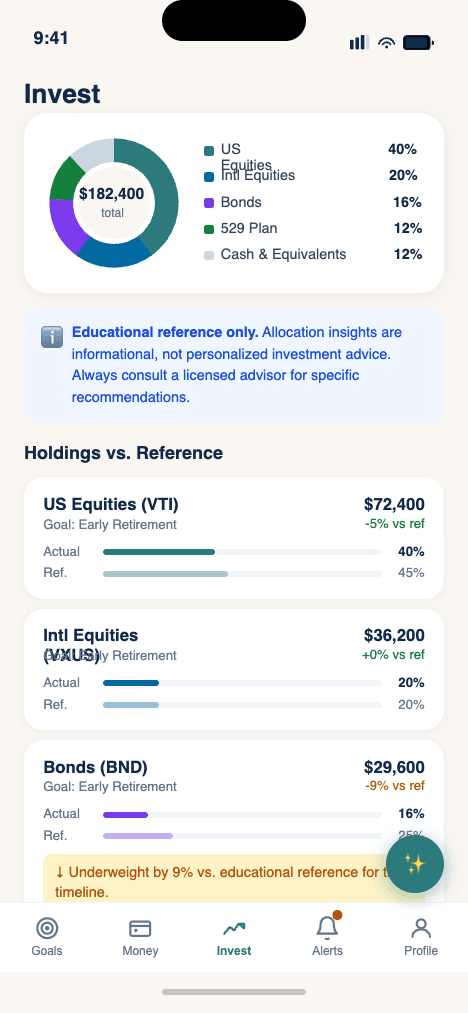
Money tab
Goals dashboard with alignment score
Invest tab
Goals · Money · Invest, three tabs, one continuous story
The Idea

From account-first to life-first finance

Most adults have capable financial tools, yet financial anxiety is at record highs. Finance is presented as accounts and balances, but people think in goals, the people they love, and the milestones they fear missing.

I led this concept end-to-end: synthesizing research into a comprehensive PRD, defining the IA and visual system, then building a working, navigable iOS prototype with an AI-assisted toolchain.

Capabilities
Market & User ResearchProduct DesignPRD & DocumentationAI Spec & Prototype
Role
Lead Product Designer
Duration
Self-directed, 2026
Platform
iOS (mobile)
Toolchain
Claude · CursorGitHub
Industry
FinTechPersonal Finance
Data
Synthetic personas
Challenge

Understanding the money–life gap

Before a single screen, I mapped why a decade of personal-finance tools left the same need unmet. Five gaps surfaced repeatedly, and each became a design constraint rather than a feature request.

GAP 01
No single story
People hold 3–7 accounts; every app shows a slice. The user is left as the integrator.
GAP 02
Backward-looking
Tools report what you spent. The question people ask is forward: what does this mean for what I want?
GAP 03
Shame as default
Deficit framing drives avoidance. People want to be treated as adults making trade-offs.
GAP 04
Investing fear
Most users don't want to pick stocks. They want to know if what they hold matches what they're trying to achieve.
GAP 05
Opaque automation
AI nudges are everywhere; their reasoning rarely is. People accept guidance only when they understand its basis.
THE OPENING
Timing
Open Banking (CFPB §1033), cheap explainable AI, and Mint's sunset created a rare moment of willingness to switch.
Goals & Alignment

One number for "am I on track?"

The headline isn't a balance, it's the Goal Alignment Score: a single interpretable read on whether today's behaviour serves tomorrow's goals. Tap it and every weighted component is revealed.
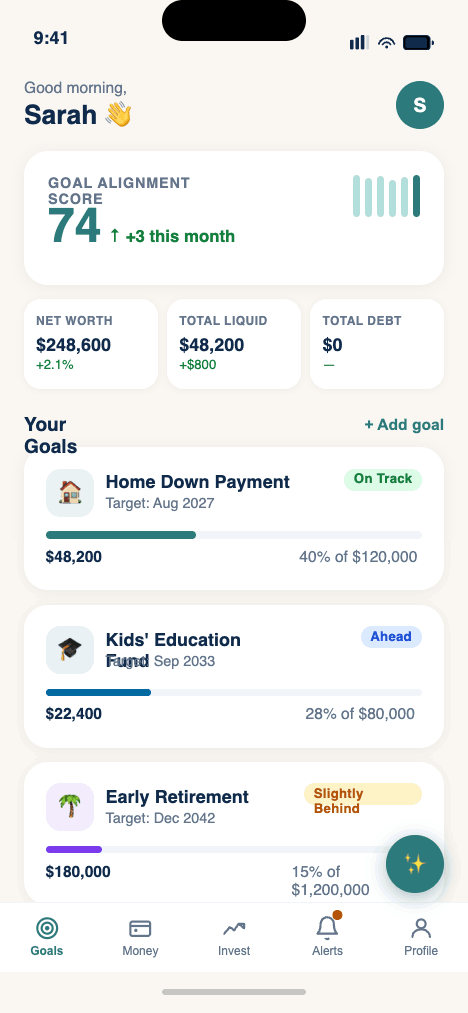
Goal dashboard with alignment score 74
Alignment score, composed, never a black box
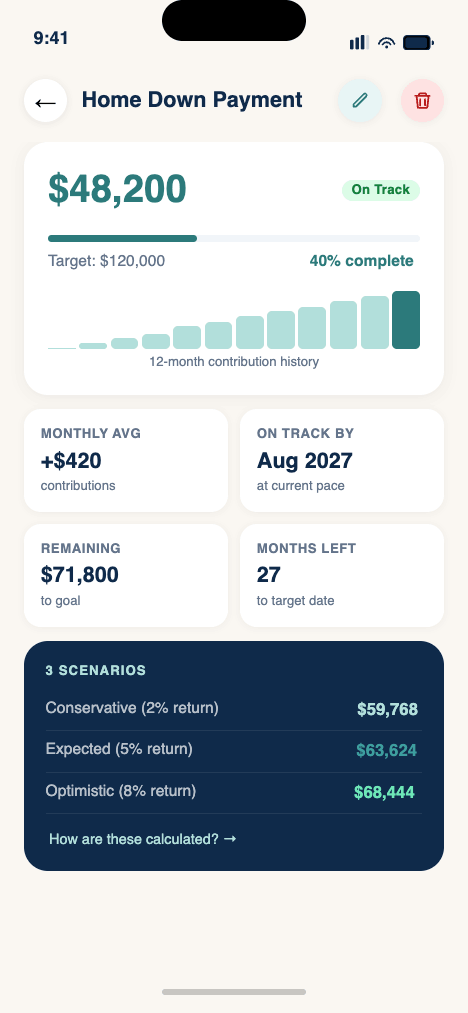
Goal detail with projections
Goal detail, history, scenarios, inline edit
Approach

A calm system for a tense subject

Money is emotional. The system is deliberately quiet: a warm, paper-like canvas for everyday surfaces, deep navy reserved for moments that carry weight, and a single trustworthy teal for action. Six principles break ties when decisions conflict.

5
Persistent tabs, no hidden menus
1
Most-recommended action per surface
01
Goals are the spine
Every screen renders state through the user's goals, spending, investing, and net worth are all read as goal impact.
02
Show the math
Every projection and nudge surfaces a plain-language "Why?", the arithmetic is always one tap away.
03
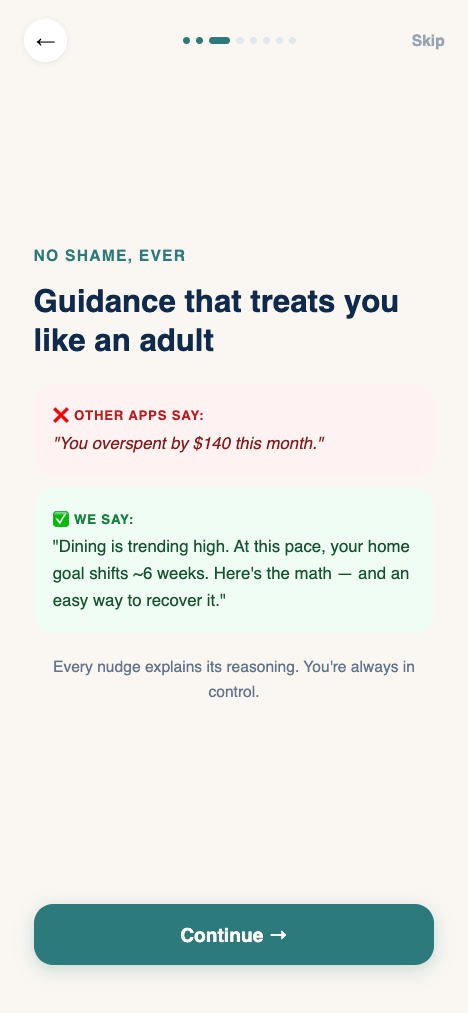
Compassion over shame
No deficit framing, no streaks that punish breakage. Drift always comes with a concrete path back.
04
Information, not advice
The assistant explains, projects, and educates, it never issues personalized buy/sell recommendations.
05
Privacy is a product
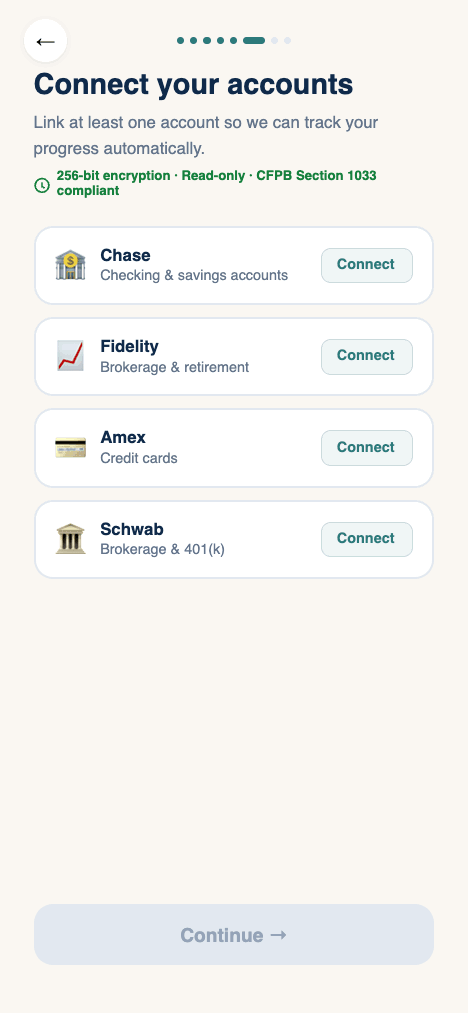
Users see what data we hold, why, and can revoke it easily, read-only access, CFPB §1033 compliant.
Spending Intelligence

Every transaction, rendered through your goals

Spending and investing as one continuous narrative. An $88 dinner becomes "42 days later on your home goal", with the math one tap away and a path to recover it.
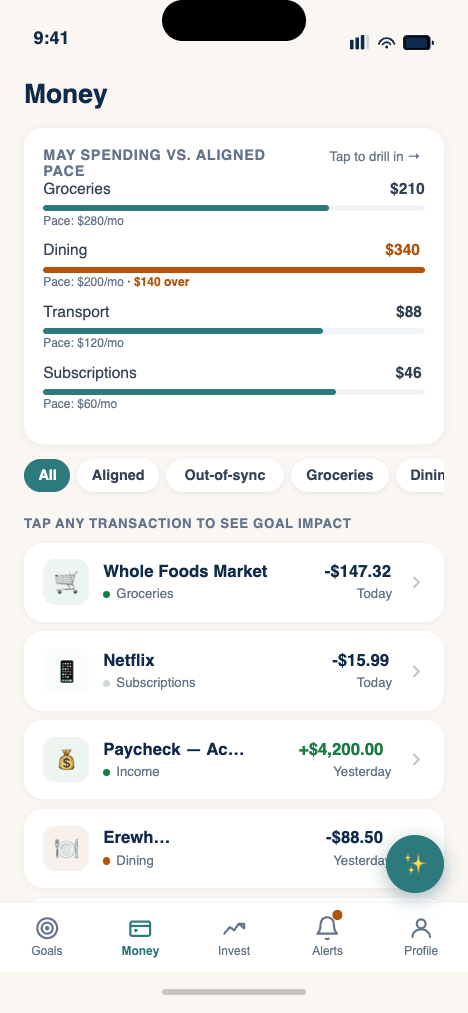
Money tab, spending vs aligned pace
The spend, pace vs. aligned
Goal detail with projections
The goal each dollar moves
Goals dashboard with alignment score
The Alignment Score it feeds
Outcome

Earning trust, screen by screen

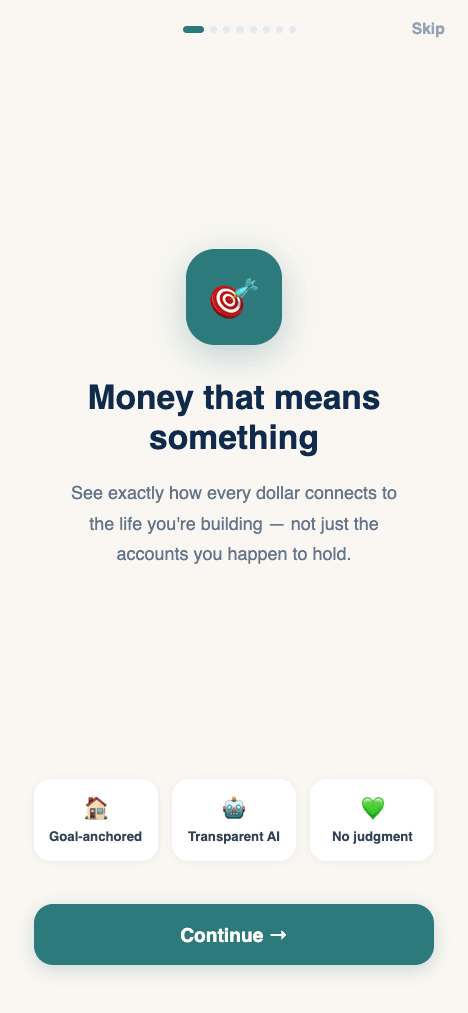
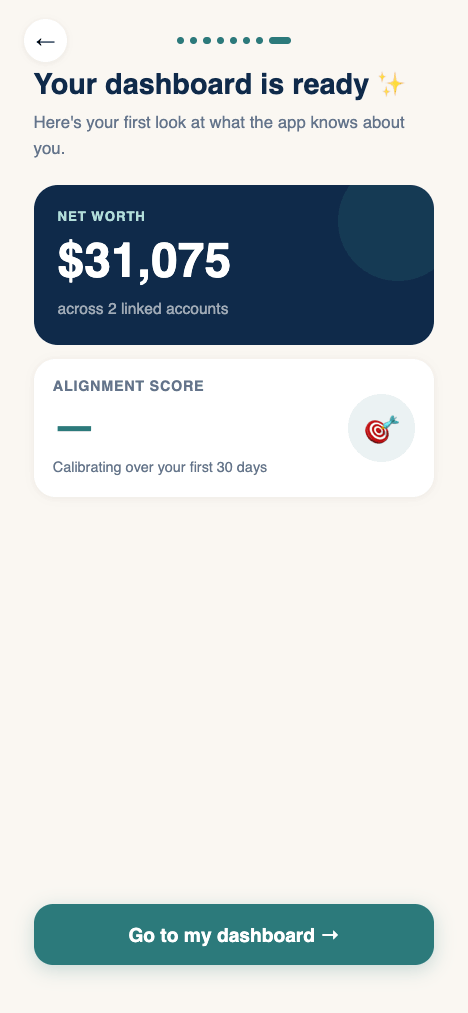
Onboarding teaches the product's worldview and earns permission to connect a financial life, opening with values before ever asking to link an account, and closing on a populated dashboard with an animated net-worth reveal.

Values before asks

The first screens sell the philosophy, connection, transparency, compassion, so linking an account feels earned, not extracted.

Guidance you can interrogate

The conversational assistant is grounded in the user's own data and bounded by a strict information-not-advice line, a trust moat, not a limitation.

The "Why?" pattern

Anywhere a number, projection, or nudge appears, a "Why?" reveals the plain-language arithmetic behind it. Trust as a repeating UI pattern.

Onboarding

Earning trust in eight screens

Welcome screen
01 · Money that means something
Compassion screen
03 · No shame, ever
Account linking
06 · Read-only, §1033
Dashboard reveal
08 · Your dashboard, ready
The Opportunity

Sizing the bet

0M
U.S. adults in the addressable market (TAM)
0M
Serviceable market earning $40K–$250K
0
Incumbent PFM archetypes benchmarked
3–0
Financial accounts the average person juggles
FIGURES ARE DESK-RESEARCH ESTIMATES FRAMING A CONCEPT, NOT VALIDATED PRODUCT METRICS.

Translating a $145 grocery bill into a position on a 30-year retirement trajectory is work most people can't do. The product's whole job is to do that translation, in public, every day.

Design principle · Goals-Driven Finance
Live · Interactive Prototype

Try the working build

A fully interactive prototype, tap through goals, spending intelligence, the AI assistant, and onboarding. It runs live, right here.

Version Showcase Editorial